Table of Contents
Before we dive into the human stories and executive narrative, let’s let the hard data speak for itself. These aren’t future projections or abstract forecasts—these are real jobs already replaced by AI in 2025. The pace and scale are unprecedented, and they’re happening right now.
- 77,999 jobs directly attributed to AI automation in 2025
- 491 people losing their jobs to AI every single day (77,999 ÷ ~160 days)
- 15,000+ Microsoft employees cut while 30% of company code is now AI-written
- 8,000 IBM HR workers replaced by AI agents in a single quarter
- 20,000 UPS logistics jobs eliminated through machine learning optimization
- 41% of global employers plan AI-driven workforce reductions within five years
Now, let’s dig into what’s really happening behind these staggering numbers.
The insider truth: While CEOs promise AI will “augment human potential,” 491 people lose their jobs to artificial intelligence every single day. Here’s what’s really happening behind the corporate spin.
And this is the projected reality – think from a different perspective.
When Klarna CEO Sebastian Siemiatkowski announced that AI chatbots were handling two-thirds of customer service conversations, he didn’t mention the hundreds of human agents who suddenly became “redundant.” When IBM’s Arvind Krishna proudly declared that AI agents were revolutionizing HR operations, he glossed over the 8,000 employees who lost their jobs to make room for the bots.
This is the reality of AI job displacement in 2025: a carefully orchestrated corporate narrative that celebrates “efficiency gains” while real people lose their livelihoods at an unprecedented pace.
Why Companies Hide AI Job Displacement
Corporate America has perfected the art of AI job displacement denial. Companies deploy euphemisms like “workforce optimization,” “organizational restructuring,” and “strategic realignments” to mask what’s really happening: systematic replacement of human workers with artificial intelligence.
The Language of Deception
UPS CEO Carol Tomé provides a masterclass in corporate doublespeak. When the company laid off 20,000 workers after implementing machine learning systems, Tomé insisted the cuts weren’t “directly related to AI.” Yet in the same breath, she credited machine learning algorithms for enabling the company to operate with a dramatically smaller workforce.
Duolingo mastered this semantic game when it eliminated 10% of its contractor workforce for AI translation services. Company spokesperson clarified: “No employees were laid off.” The hundreds of contractors who lost their translation work might disagree with that distinction.
The Lone Truth-Teller
Among the corporate obfuscation, IBM stands out as the rare company that admitted the truth. When CEO Arvind Krishna announced 8,000 HR job cuts, he didn’t hide behind euphemisms. “Our AI agents now handle employee queries, paperwork processing, and data organization,” Krishna stated plainly. “These roles are no longer necessary.”
This brutal honesty revealed what other companies desperately try to hide: AI isn’t augmenting human work—it’s replacing it entirely.
The Real Numbers: What’s Actually Happening
Behind the corporate spin lies a stark mathematical reality. According to comprehensive layoff tracking, 131,131 tech workers have lost their jobs across 435 separate events in 2025 alone. That’s 491 people every single day—not in some distant future, but right now, today.
The Acceleration Is Unprecedented
Workforce displacement research analyzing millions of employment records shows the pace of AI-driven job loss is unlike anything in modern economic history. While historical technological disruptions unfolded over decades, AI displacement is happening in months.
Consider the numbers:
- 77,999 tech jobs directly attributed to AI automation in 2025
- Daily displacement rate of 491 workers
- Geographic concentration with North America leading at 70% automation adoption
Industry-Specific Devastation
The impact varies dramatically by sector, but the pattern is consistent: routine, predictable work disappears first.
Customer Service: Companies are targeting 80% automation by 2025. Klarna’s AI chatbots now handle the work that required hundreds of human agents just two years ago.
Data Entry: Research projects 7.5 million positions will be eliminated by 2027, representing the largest single-occupation job loss prediction.
Software Engineering: Perhaps most shocking, 20% of entry-level programming positions have vanished since late 2022, as companies discover AI can generate acceptable code for basic functions.
The Corporate Admission
Global survey data reveals that 41% of employers worldwide intend to reduce their workforce due to AI within five years. More telling: 30% have already begun replacing workers with AI tools like ChatGPT and similar platforms.
Major Company Breakdown
While most companies hide behind euphemisms, documented evidence reveals the scope of AI-driven job displacement across major corporations.
Microsoft: The Software Giant’s Silent Purge
Microsoft CEO Satya Nadella frequently champions AI as “empowering every person and organization on the planet to achieve more.” The reality is more complex. Internal data shows that 30% of Microsoft’s code is now written by AI systems, yet the company eliminated 15,000 positions between May and July 2025.
The most revealing detail: Over 40% of these layoffs targeted software engineers—the very professionals who built the AI systems now replacing them. Microsoft’s own tools are writing code faster and cheaper than human programmers, making entire development teams redundant.
“We’re seeing the classic innovator’s dilemma,” explains Daron Acemoglu, MIT economics professor and co-author of “Power and Progress.” “The companies creating AI tools are the first to discover they don’t need as many humans to operate them.”
IBM: When HR Becomes AI
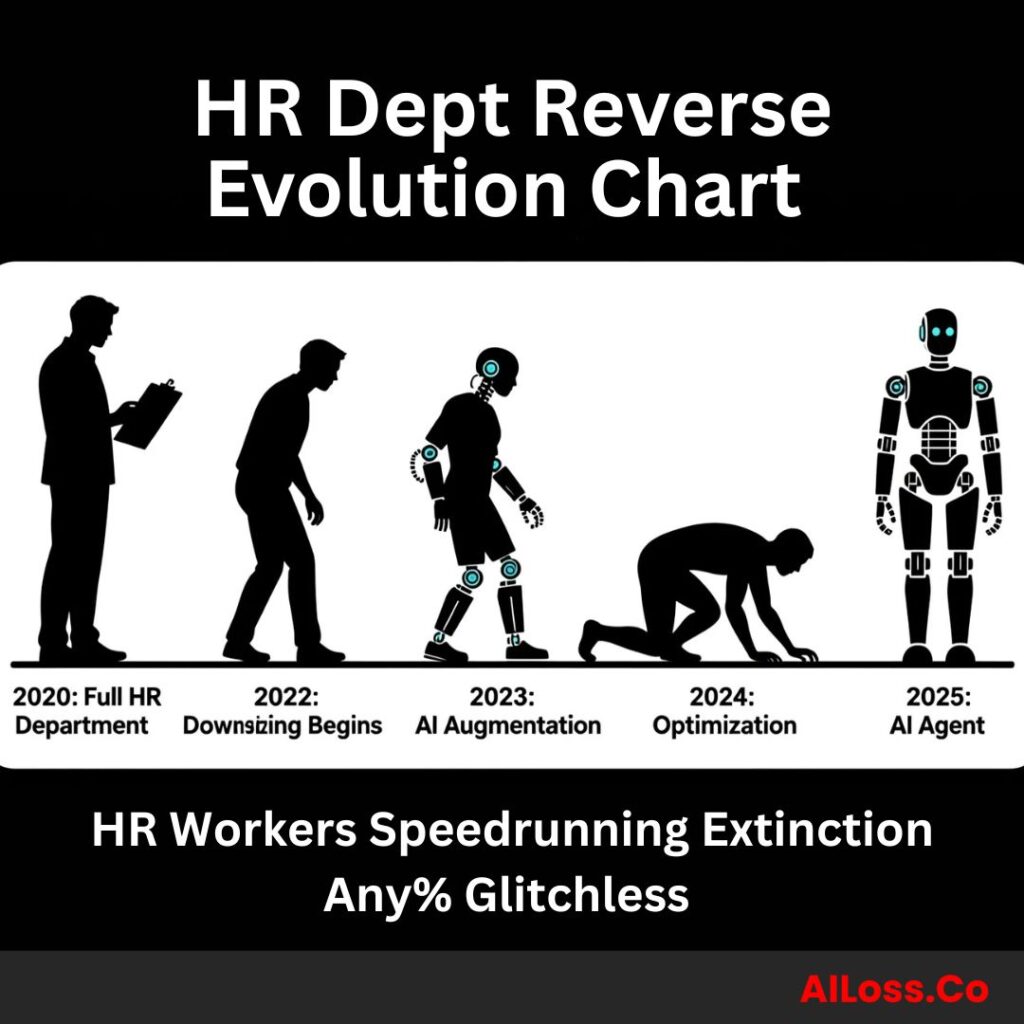
IBM’s transformation represents the most dramatic example of AI replacing white-collar professionals. The company eliminated 8,000 HR positions after deploying AI agents capable of handling employee queries, processing paperwork, and managing data organization.
CEO Arvind Krishna’s internal memo was remarkably candid: “Our AI systems can process employee requests 24/7, handle complex policy questions, and manage workforce analytics without breaks, vacation time, or healthcare costs. The economic logic is undeniable.”
The IBM case is particularly significant because it shattered the assumption that “knowledge work” was safe from automation. These weren’t factory jobs or call center positions—they were college-educated professionals with years of experience.
Amazon: The Everything Company’s Everything Cut
Amazon CEO Andy Jassy sent perhaps the most ominous signal about AI’s impact on employment. In an internal memo obtained by industry sources, Jassy stated that AI will “reduce our total corporate workforce” as the company achieves efficiency gains from automation.
Amazon has eliminated over 27,000 positions since 2022, with particular focus on customer service and operational roles that can be automated. The company’s approach is systematic: identify routine tasks, deploy AI solutions, eliminate human positions.
The Broader Pattern
Comprehensive tracking of major corporations reveals similar patterns across industries:
Salesforce: Reduced customer support staff from 9,000 to 5,000 through AI agent deployment, representing a 44% workforce reduction in that division.
UPS: Machine learning systems enabled 20,000 layoffs by optimizing routes and automating logistics decisions previously made by human planners.
Duolingo: Eliminated 10% of translation contractors after AI systems achieved acceptable quality for most language pairs.
The Demographics of Displacement: Who Gets Hit First
Groundbreaking research analyzing 25 million workers by Stanford economists reveals that AI job displacement follows predictable demographic patterns—and the results should alarm anyone under 30.
Entry-Level Workers: The Canaries in the Coal Mine
The data is stark: Workers aged 22-25 experienced a 13% employment drop in AI-exposed fields since early 2022. Meanwhile, older workers in identical industries saw 6-9% employment growth. The message is clear: companies are replacing expensive entry-level workers with AI systems, while retaining experienced employees for complex tasks.
“We’re witnessing the elimination of the traditional career ladder,” warns Erik Brynjolfsson, Director of Stanford’s Digital Economy Lab. “Entry-level positions have historically been where people learned skills and proved their value. AI is removing those stepping stones.”
The impact on recent graduates is particularly severe. Unemployment rates for college graduates aged 22-24 reached 5.8% in 2025—unusually high for this demographic and directly correlated with AI adoption in their target industries.
The Gender Divide
Economic analysis reveals that 58.87 million women occupy positions highly exposed to AI automation, compared to 48.62 million men. This disparity reflects historical job segregation: women are overrepresented in administrative, customer service, and data processing roles—exactly the positions AI targets first.
The implications extend beyond immediate job loss. “Women are disproportionately concentrated in roles that AI can automate more easily,” explains MIT’s Daron Acemoglu. “This creates a compounding disadvantage in an already unequal labor market.”
Age and Anxiety
Survey research shows that workers aged 18-24 are 129% more likely to worry about AI job displacement compared to workers over 40. This isn’t paranoia—it’s pattern recognition. Younger workers correctly identify that they’re disproportionately vulnerable to AI replacement.
The Geographic Reality: Where Jobs Are Vanishing
AI job displacement isn’t distributed evenly across the globe. Advanced economies are experiencing the heaviest impact, with 60% of jobs in developed countries facing some level of AI exposure, compared to just 26% in low-income nations.
United States: The Epicenter
America leads the world in both AI development and AI-driven job displacement. Economic projections indicate that 47% of US workers face automation risk within the next decade, with 30% of current positions potentially automated by 2030.
The geographic concentration is striking. Tech hubs like Seattle, San Francisco, and Austin—previously symbols of economic prosperity—are experiencing the highest rates of AI-related unemployment as companies automate the very jobs that built these cities.
The Global Labor Shift
While American jobs disappear to AI, companies simultaneously expand operations in countries like India, where skilled professionals work for significantly lower wages. This creates a double displacement: AI eliminates routine work, while remaining jobs migrate to lower-cost regions.
“We’re seeing a fundamental restructuring of global labor markets,” observes Susan Lund, McKinsey Global Institute partner. “AI doesn’t just replace jobs—it changes where the remaining work gets done.”
The Financial Reality: Follow the Money
Corporate executives don’t deploy AI from altruistic motives—they’re responding to inexorable economic pressure. Analysis of AI implementation costs reveals that companies save $8 billion annually from AI chatbots alone, not including savings from other forms of automation.
The ROI of Replacement
The mathematics are compelling from a corporate perspective. A human customer service representative costs approximately $35,000 annually including benefits. An AI chatbot handling equivalent volume costs roughly $2,000 per year in computing resources. The 17:1 cost ratio makes the decision inevitable.
“Companies aren’t being evil—they’re being rational,” explains Avi Goldfarb, professor at University of Toronto’s Rotman School of Management. “When AI can perform a task at 5% of the human cost, the market rewards companies that make the switch.”
Wall Street Expectations
Financial industry analysis projects that 200,000 banking sector jobs will be eliminated within 3-5 years as AI systems handle loan processing, risk assessment, and customer inquiries. Investment firms are already rewarding companies that demonstrate AI-driven cost reductions with higher stock valuations.
This creates a feedback loop: companies that eliminate human workers see stock prices rise, encouraging more aggressive AI deployment across industries.
The Timeline Acceleration: Why Predictions Were Wrong
Economic forecasters consistently underestimated the speed of AI job displacement. The seminal 2013 Oxford study by Carl Benedikt Frey and Michael Osborne predicted that 47% of US jobs were at risk “in a decade or two.” That timeline has compressed dramatically.
What Changed the Game
Three factors accelerated AI job displacement beyond all predictions:
Performance Breakthroughs: AI systems achieved human-level performance in many tasks years ahead of schedule. Large language models like GPT-4 and Claude demonstrated capabilities that researchers expected would take decades to develop.
Economic Pressure: Rising interest rates and inflation forced companies to cut costs immediately rather than gradually. AI offered the fastest path to significant expense reduction.
Proven Business Cases: Early AI adopters demonstrated clear return on investment, encouraging rapid widespread adoption across industries.
“The timeline collapsed because the technology worked better than expected, and economic conditions demanded immediate implementation,” explains MIT’s Erik Brynjolfsson. “We went from ‘this might happen someday’ to ‘this is happening right now’ almost overnight.”
The New Reality
Current economic models project that 92 million jobs globally could be displaced by 2030—just five years away. More alarmingly, 14% of the global workforce will be forced to change careers entirely due to AI automation.
The acceleration continues. Companies that spent 2022-2023 experimenting with AI are now deploying it at scale, translating pilot programs into mass layoffs.
The Jobs Already Gone: Specific Examples
Beyond statistics and projections, AI job displacement has real faces and stories. Here are documented cases of specific roles that have already vanished:
Customer Service Representatives
Klarna’s Transformation: The Swedish fintech company’s AI customer service chatbot now handles the equivalent of 700 full-time agents. CEO Sebastian Siemiatkowski announced that the AI system resolves customer issues in 2 minutes on average, compared to 11 minutes for human agents.
The human cost: Hundreds of customer service jobs eliminated in Stockholm, with no plans for redeployment or retraining.
Salesforce’s Scale: The CRM giant reduced its customer support division from 9,000 to 5,000 employees through AI agent deployment. The 44% workforce reduction was described internally as “efficiency optimization,” but affected employees received standard severance packages with no option to transition to other roles.
Content Creation and Translation
Duolingo’s Language Lesson: The language-learning platform eliminated 10% of its translation contractors after deploying AI systems capable of acceptable translation quality for most language pairs.
Maria Gonzalez, a former Spanish-English translator for Duolingo, describes the abrupt transition: “They sent an email saying our services were no longer needed, effective immediately. No warning, no transition period. The AI could do in seconds what took me hours, but at a quality level that was ‘good enough’ for their purposes.”
Marketing Content Automation: Industry surveys indicate that 81.6% of digital marketers expect AI to replace content writers within two years. Companies are discovering that AI-generated blog posts, social media content, and product descriptions cost pennies compared to human-created content.
Data Processing and Analysis
IBM’s HR Revolution: The 8,000 eliminated HR positions weren’t just answering employee questions. AI systems now handle complex tasks like:
- Processing job applications and conducting initial candidate screening
- Analyzing employee performance data and generating review summaries
- Managing benefits enrollment and policy questions
- Conducting exit interviews and processing termination paperwork
“The AI doesn’t just replace what we did—it does it better,” admits former IBM HR specialist Jennifer Chen. “It never forgets policy details, never has a bad day, and can handle 1,000 employee queries simultaneously.”
The Myths vs Reality
Corporate messaging around AI job impact relies heavily on comforting myths that don’t align with documented evidence.
Myth: “AI Will Create More Jobs Than It Destroys”
The Reality: While AI does create new positions, they require dramatically different skills. Research shows that 77% of AI-related job openings require master’s degrees or higher, while most displaced workers have bachelor’s degrees or less.
The World Economic Forum projects that 97 million new roles will emerge by 2025, but these positions cluster in highly specialized areas like AI system training, algorithmic bias detection, and human-AI interaction design. A displaced customer service representative cannot easily transition to training neural networks.
“The ‘creative destruction’ narrative assumes workers can seamlessly move from old jobs to new ones,” explains MIT’s David Autor. “But the skill requirements are so different that we’re essentially asking people to change careers entirely.”
Myth: “This Is Just Normal Economic Transition”
The Reality: The pace of AI displacement far exceeds historical technological transitions. The shift from agricultural to industrial work unfolded over decades. The move from manufacturing to services took generations. AI job displacement is happening in months.
Daily displacement rates of 491 people per day in tech alone represent unprecedented speed. For context, the entire U.S. manufacturing decline from 1990-2010 averaged 274 jobs lost per day across all manufacturing sectors.
Myth: “AI Will Augment, Not Replace Workers”
The Reality: Corporate survey data reveals that 40% of companies are using AI for automation rather than augmentation. When given the choice between AI-assisted humans or AI replacement, companies consistently choose replacement for routine tasks.
“Augmentation sounds nice in theory,” observes University of Pennsylvania’s Mauro Guillen. “But when AI can perform a task independently at a fraction of the cost, the economic incentive always favors replacement.”
What This Means for You
The abstract statistics of AI job displacement become personal when you assess your own vulnerability. Here’s how to evaluate your risk:
Immediate Risk Assessment
If you’re aged 22-25: You face the highest displacement risk. Stanford research shows 13% employment decline in this age group for AI-exposed occupations. Companies view entry-level workers as expensive training investments when AI can perform similar tasks immediately.
If you work in customer service: 80% automation risk by 2025 makes this among the most vulnerable professions. Companies like Klarna demonstrate that AI chatbots can handle complex customer interactions at a fraction of human cost.
If you’re in data entry or processing: 7.5 million positions are projected for elimination by 2027, representing near-total industry elimination. AI systems excel at recognizing patterns and processing structured information.
If you’re an entry-level software engineer: 20% of positions have already disappeared since late 2022. AI coding assistants can generate acceptable code for routine functions, reducing demand for junior developers.
The Skills That Still Matter
Despite AI’s capabilities, certain human skills remain irreplaceable—at least for now:
Complex Problem-Solving: AI excels at pattern recognition but struggles with novel problems requiring creative solutions. The ability to analyze unprecedented situations and develop innovative approaches remains distinctly human.
Emotional Intelligence: While AI can simulate empathy, genuine human connection and emotional understanding remain valuable in leadership, therapy, sales, and customer relations requiring trust and rapport.
Strategic Thinking: AI processes information but doesn’t inherently understand business context, competitive dynamics, or long-term strategic implications of decisions.
“The workers who survive and thrive will be those who can do what AI cannot: think creatively, build relationships, and solve problems that don’t have precedent,” advises Harvard Business School’s Karim Lakhani.
Preparing for the New Reality
Skill Development: Focus on abilities that complement rather than compete with AI. Learn to work with AI tools rather than ignore them. The future belongs to humans who can effectively collaborate with artificial intelligence.
Career Diversification: Avoid roles that involve routine, predictable tasks. Seek positions requiring human judgment, creativity, and interpersonal skills that remain difficult for AI to replicate.
Continuous Learning: The half-life of job skills is shrinking rapidly. Commit to lifelong learning and regular skill updates to stay relevant in an AI-augmented workplace.
The Uncomfortable Truth
Goldman Sachs estimates that 300 million jobs globally face AI displacement risk—nearly one in every ten jobs worldwide. McKinsey projects that 14% of the global workforce will be forced to change careers entirely by 2030 due to automation.
These aren’t distant projections. They’re descriptions of a transformation already underway. While executives celebrate AI’s potential and politicians promise retraining programs, 491 people lose their jobs to artificial intelligence every single day.
The question facing workers today isn’t whether AI will impact employment—it’s how quickly you can adapt to a world where it already has. Companies won’t wait for workers to adjust, regulators to intervene, or society to develop ethical frameworks. The economic logic of AI deployment is too compelling, and competitive pressures too intense.
The real number of jobs AI has taken isn’t hidden in corporate euphemisms or buried in research papers. It’s written in the lives of 131,131 people who discovered that their skills, experience, and dedication couldn’t compete with algorithms that work 24/7 for pennies on the dollar.
The AI job displacement revolution isn’t coming. It’s here. And it’s accelerating.
Sources include: Stanford Economic Research analyzing 25 million workers, Goldman Sachs Global Workforce Analysis, World Economic Forum Future of Jobs Report 2025, McKinsey Global Institute projections, real-time layoff tracking from Layoffs.fyi, TechCrunch industry analysis, multiple company SEC filings and WARN notices, and documented CEO statements and internal communications.